
From a Glasgow Shipping Advertisement to Disaster at Sea
The State of Florida Steamship – On 20 August 1883, an advertisement in The Edinburgh Courant offered readers a passage from Glasgow to New York aboard the steamships of the State Line. Among the vessels listed was the State of Florida, scheduled to sail on Friday, 7 September, calling at Larne Harbour in Ireland.
Within eight months, the State of Florida would be lost in the Atlantic.

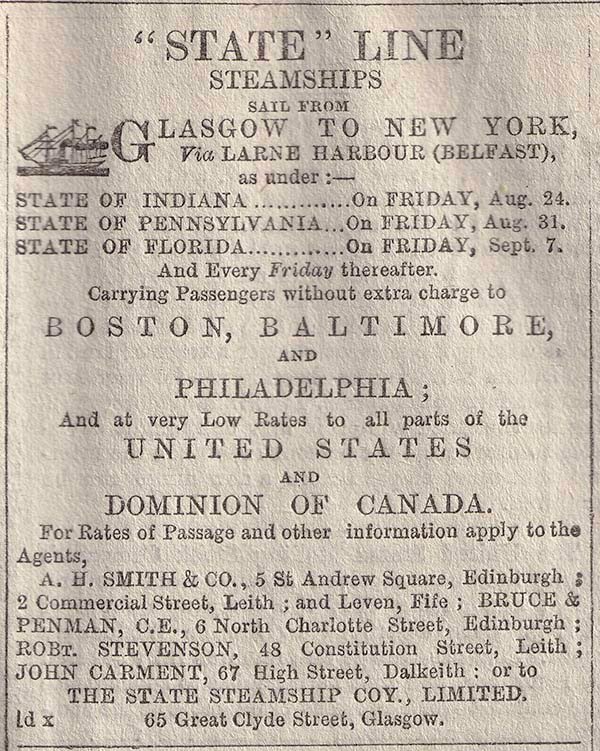
“STATE” LINE
STEAMSHIPS
SAIL FROM
GLASGOW TO NEW YORK,
Via LARNE HARBOUR (BELFAST),
as under:—
STATE OF INDIANA ………… On FRIDAY, Aug. 24.
STATE OF PENNSYLVANIA …. On FRIDAY, Aug. 31.
STATE OF FLORIDA ……….. On FRIDAY, Sept. 7.
And Every Friday thereafter.
Carrying Passengers without extra charge to
BOSTON, BALTIMORE,
AND
PHILADELPHIA;
And at very Low Rates to all parts of the
UNITED STATES
AND
DOMINION OF CANADA.
For Rates of Passage and other information apply to the Agents,
A. H. SMITH & CO., 5 St Andrew Square, Edinburgh;
2 Commercial Street, Leith; and Leven, Fife;
BRUCE & PENMAN, C.E., 6 North Charlotte Street, Edinburgh;
ROBT. STEVENSON, 48 Constitution Street, Leith;
JOHN CARMONT, 67 High Street, Dalkeith; or to
THE STATE STEAMSHIP COY., LIMITED,
65 Great Clyde Street, Glasgow.
The advertisement promoted travel beyond New York, offering onward passage to Boston, Baltimore and Philadelphia without extra charge, and low rates to other parts of the United States and Canada. Enquiries could be made through agents in Edinburgh, Leith and Dalkeith, or directly to the State Steamship Company at 65 Great Clyde Street, Glasgow.
The ship had strong connections with Glasgow. Built by the London & Glasgow Engineering and Iron Shipbuilding Company at Govan, she was an iron steamship of about 3,138 gross tons. She had previously sailed as the Queen Margaret before joining the Glasgow-based State Line in 1880. Her work carried passengers and cargo between Scotland and North America.
Sinking of the State of Florida Steamship
The State of Florida left New York for Glasgow on 12 April 1884. On the night of 18 April, it collided with the Canadian sailing ship called the Ponema in the middle of the Atlantic Ocean, about 1,200 miles west of Ireland. Both ships sank.
The ship’s doctor, Dr. Andrew Steele, survived. He told a newspaper that it was a clear, starry night when there was a sudden command to reverse the engines. The sailing ship hit the steamer on its right side. According to reports, both ships sank in about fifteen minutes, so there was hardly any time to get the lifeboats into the water.
A report in the People’s Journal put the number aboard the steamer at 167, with only 44 saved; there were 123 deaths. Twelve of the Ponema’s fifteen crew also died. Other accounts give different totals, but more than 100 people unquestionably lost their lives.
Among those rescued was stewardess Jane Macfarlane, reported as the only woman to survive from the steamer. Survivors endured about a day and a half in open boats without food or water before the Norwegian barque Theresa picked them up. Some were wearing only their nightclothes.
A formal investigation into the accident was held in Glasgow on the 24th & 25th June 1884.
The Courant advertisement records the ship during her ordinary working life: a named vessel, a departure date and a Glasgow address where a passage could be booked. Read alongside the accounts of her loss, it also preserves a small part of the history of the passengers and seafarers who depended on that Atlantic service.
The State Steamship Company, established in 1872, traded as the State Line, and its Glasgow address appears at the foot of this advertisement. It carried passengers and cargo between Scotland and North America. After financial difficulties, the company went into liquidation in 1890, and the Allan Line acquired its fleet and goodwill in 1891. The name continued in use as the Allan & State Line, although the original company’s independent business had ended.